


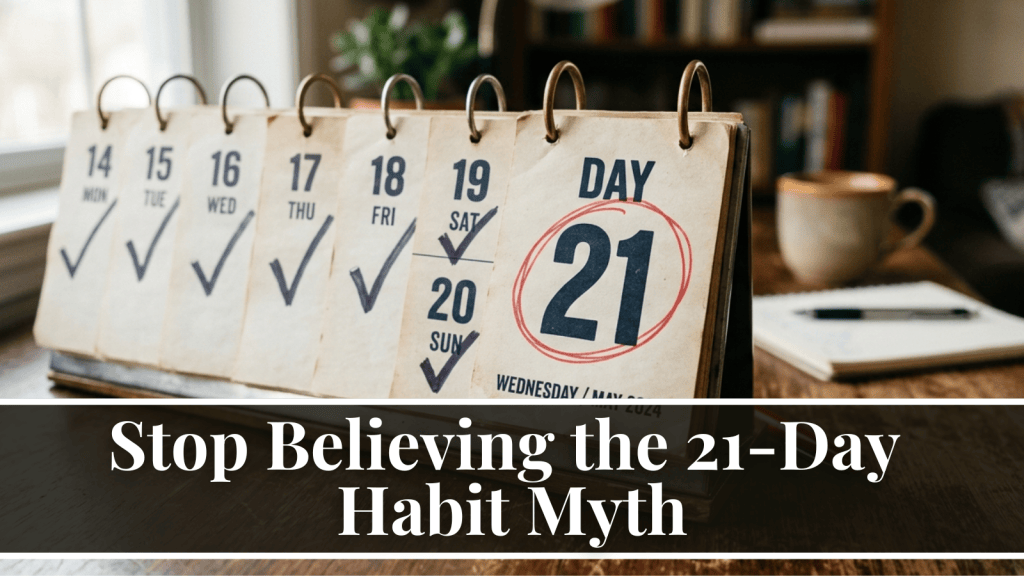
We’ve all heard it before: “It takes 21 days to form a new habit.” Whether you’re trying to start a 5:00 AM gym routine, cut out sugar, or finally master a daily journaling practice, that three-week milestone is often held up as the “magic number” where everything suddenly becomes effortless.
But is 21 days actually the finish line, or have we been following a misunderstood medical observation for decades? Let’s dive into the history of this habit forming myth and what the science actually says about rewiring your brain.


The Surprising Origin: Plastic Surgery
The 21-day rule didn’t come from a psychology lab; it came from a plastic surgery clinic. In the 1950s, Dr. Maxwell Maltz noticed a fascinating pattern among his patients.
Whether he was performing a nose job or an amputation, he observed that it took the patient about 21 days to adjust to their new appearance or to stop feeling a “phantom limb.” This observation led him to write the 1960 self-help classic, Psycho-Cybernetics.
In the book, Maltz wrote:
“These, and many other commonly observed phenomena, tend to show that it requires a minimum of about 21 days for an old mental image to dissolve and a new one to jell.”

How the Myth Spread
Maltz’s book became a massive hit, selling over 30 million copies. As the years went by, motivational speakers began to simplify his message. They dropped the word “minimum” and transformed a surgical observation into an absolute law. Before long, “minimum 21 days” became the catchy shorthand: “it takes 21 days.”
The Reality: 21 Days vs. 66 Days
While 21 days is a manageable and motivating timeframe, modern research suggests it’s rarely enough time for a behavior to become truly automatic. A landmark study by Dr. Phillippa Lally at University College London tracked 96 people as they attempted to learn new habits. The results were eye-opening:
- The Average: It took an average of 66 days for a behavior to become automatic.
- The Range: Depending on the difficulty, it took anywhere from 18 to 254 days.
Essentially, drinking a glass of water after breakfast might take you 20 days, while a complex gym routine could take you months of consistent effort.

The Three Phases of Change
Even if 21 days isn’t the “end,” it is a critical window for building momentum. Most journeys follow this cycle:
- The Honeymoon Phase (Days 1–7): Fueled by inspiration and novelty.
- The Fight-Thru (Days 8–14): The excitement wears off and your brain begins to resist the extra effort. This is where most people quit.
- The Integration (Days 15–21): You are finding your rhythm. While not yet “automatic,” the daily friction is decreasing.
The Final Verdict
The 21-day mark is a fantastic psychological milestone. It’s long enough to see results, but short enough to feel achievable. The key is to change your expectations: Day 22 is not the day you stop trying; it’s the day you celebrate that the hardest part is over.

What are yout thoughts, about Stop Believing the 21-Day Habit Myth, Iwould love to know.
Until next time, shine amongst the stars!
‘This post may contain affiliate links


If you haven’t made enough money blogging, look into taking the
Complete Guide to Make Money Blogging for only
($10… WOW 95% Off for a limited time).


Ever wondered why your “21-day challenge” didn’t make your habit stick? 🧠 I’m diving into the origin of the 21-day myth and the real science (hint: 66 days!) behind rewiring your brain. Read more on the blog! ✨ #Habits #SoftGirlEra #LavandaMichelle

