
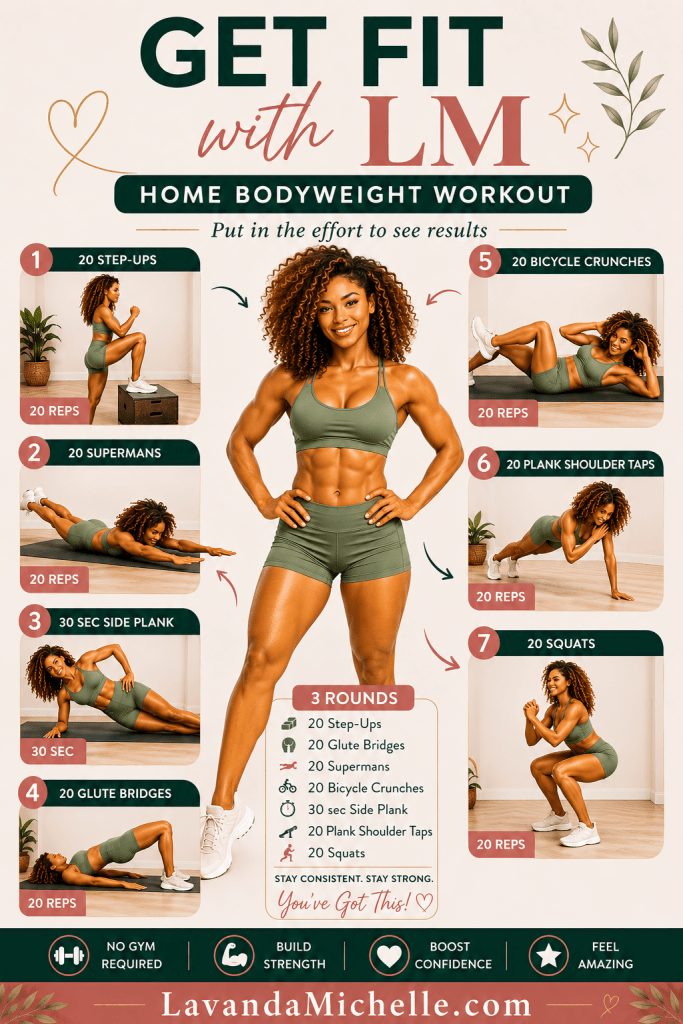
You don’t need a gym membership to get stronger, leaner, and more confident. This 3-round home bodyweight workout uses seven effective moves to target your legs, glutes, core, and shoulders while keeping your heart rate up. It’s compact enough for busy schedules, safe for most fitness levels with modifications, and can be progressed as you get stronger.
The workout plan
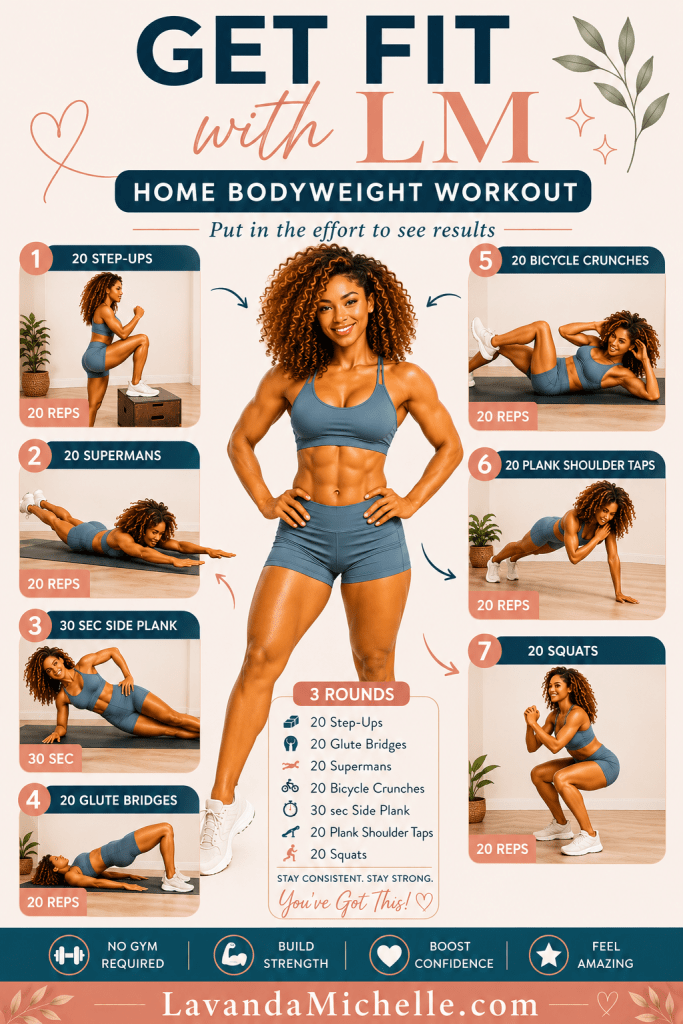
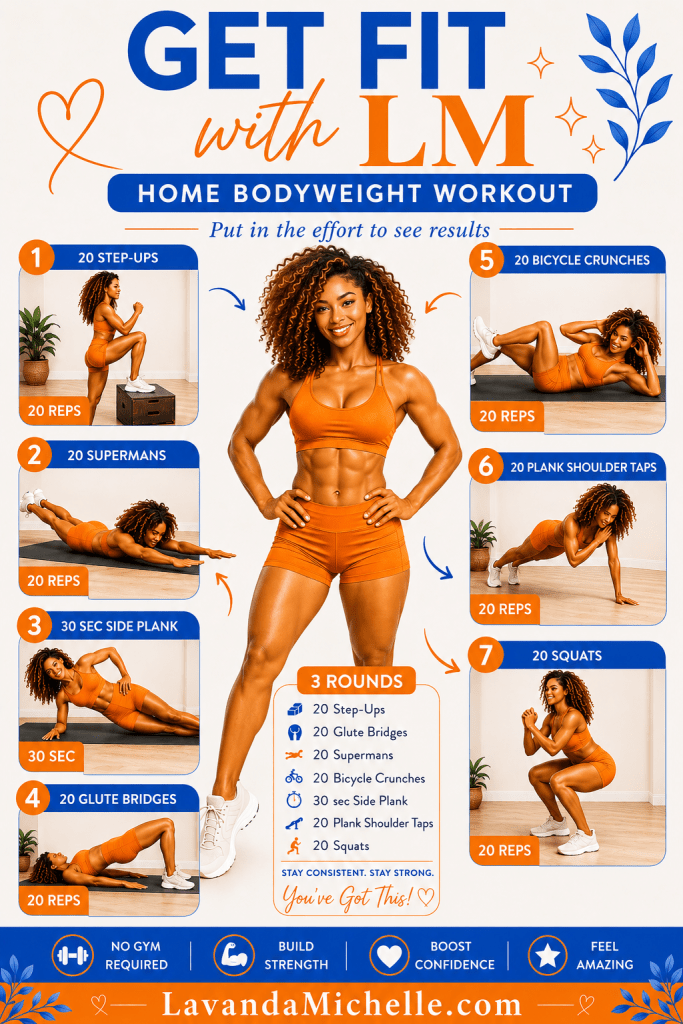
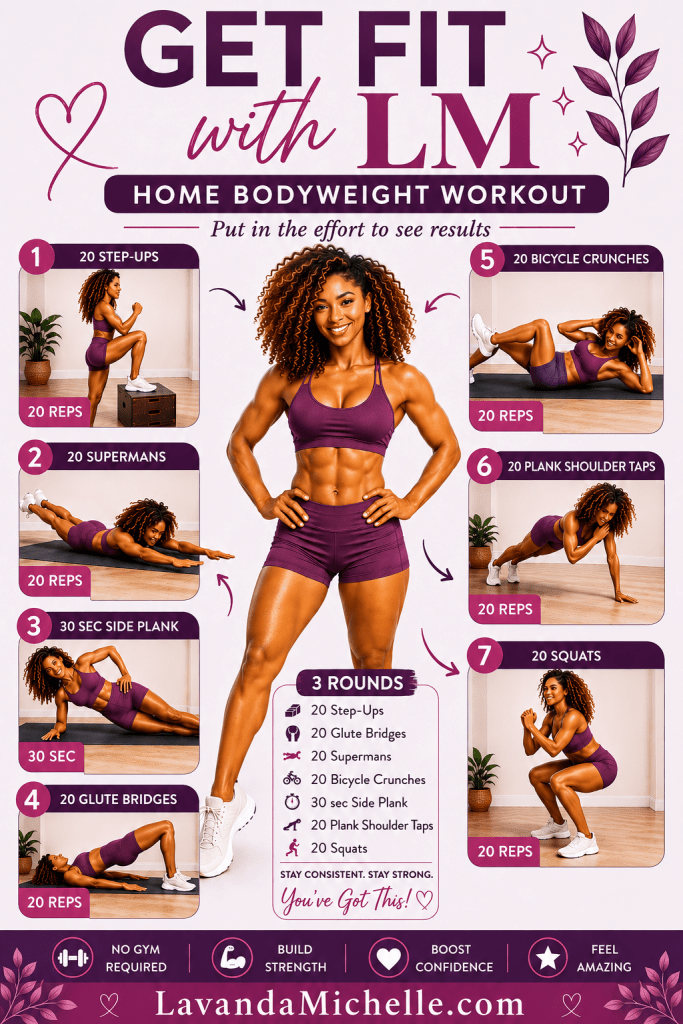
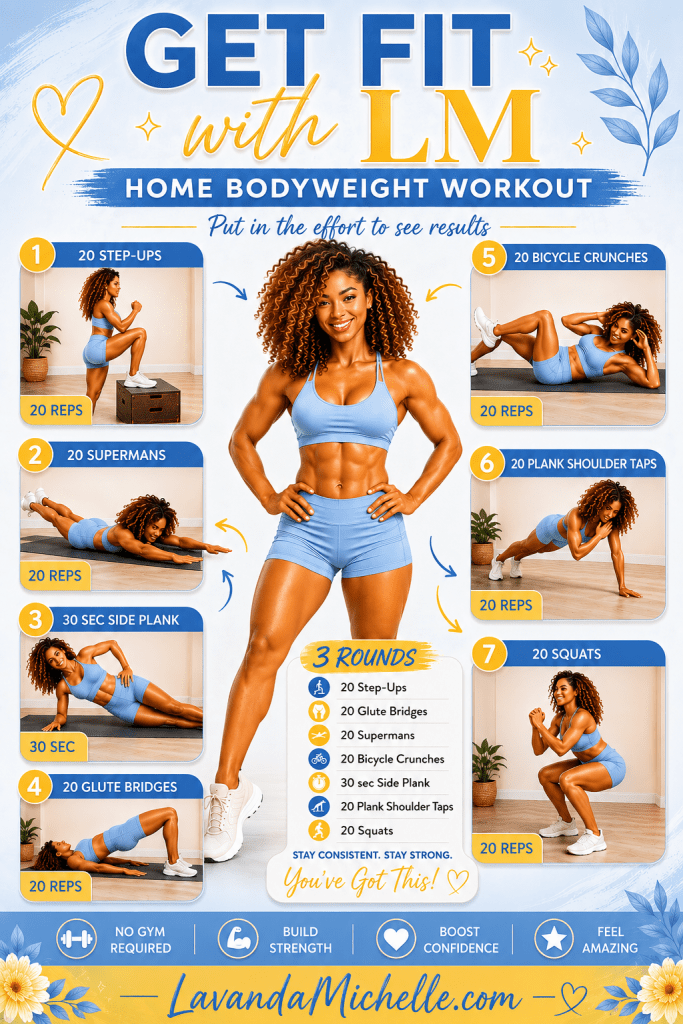
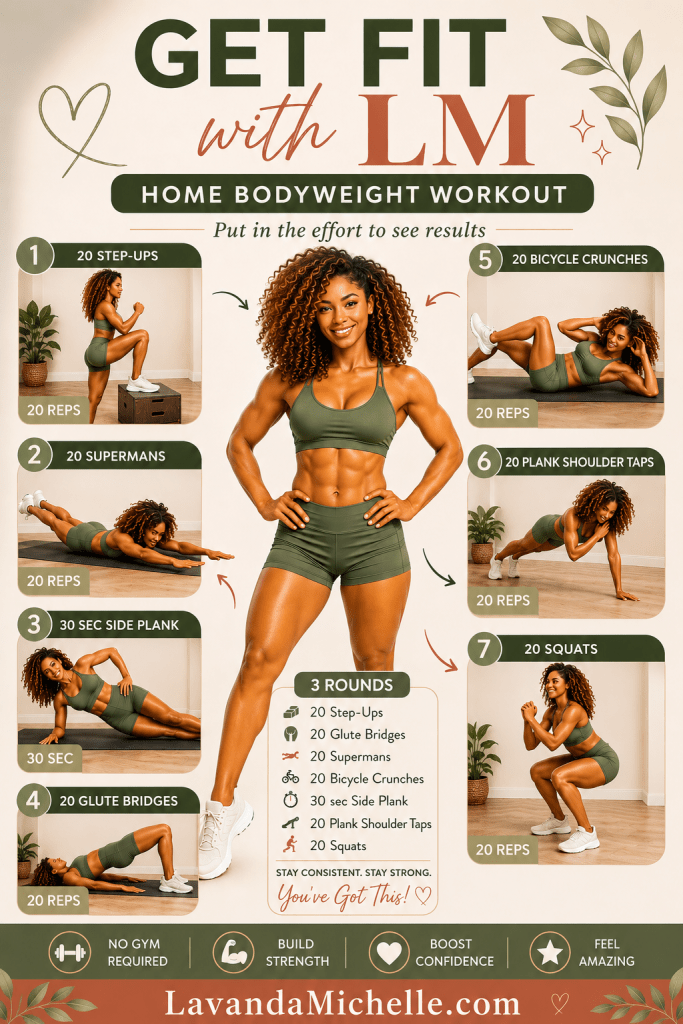
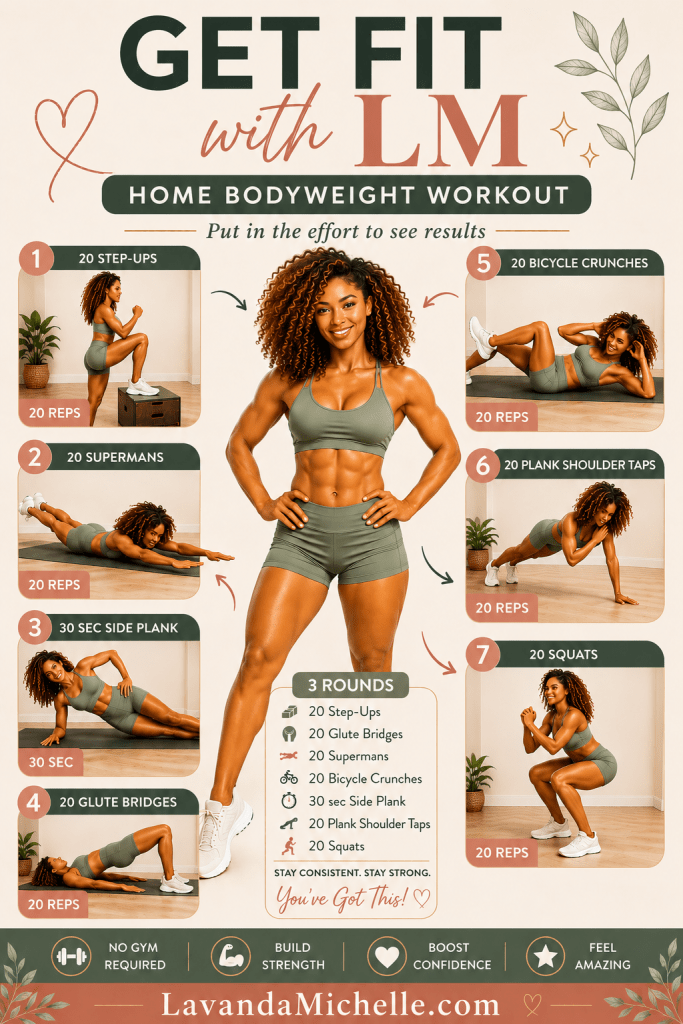
Complete 3 rounds of:
- 20 Step-Ups (total, alternate legs)
- 20 Glute Bridges
- 20 Supermans
- 20 Bicycle Crunches (total, alternating)
- 30-second Side Plank (each side)
- 20 Plank Shoulder Taps (total)
- 20 Squats
Rest 30–90 seconds between rounds, or longer if needed. New to exercise? Start with 1–2 rounds and add a round every 1–2 weeks.

How to perform each exercise, benefits, and target muscles
- Step-Ups
- How to do it: Stand facing a sturdy step, box, or bench. Step up with your right foot, drive through the right heel to lift your body fully onto the step, bring your left foot up, then step back down with the left foot first, returning to start. Alternate the leading leg so the count reaches 20 total steps. Keep your torso upright and core engaged.
- Benefits: Builds unilateral leg strength, improves balance, and trains functional movement patterns used for climbing stairs and everyday activities.
- Muscles worked: Quadriceps, glutes (gluteus maximus), hamstrings, calves, and core stabilizers.
- Modifications/progression: Use a lower step for easier reps; hold dumbbells or increase step height to progress.
- Glute Bridges
- How to do it: Lie on your back with knees bent, feet hip-width and flat on the floor. Press through your heels and squeeze your glutes to lift hips until your body forms a straight line from shoulders to knees. Pause and squeeze at the top for 1–2 seconds, then lower with control. Repeat for 20 reps.
- Benefits: Strengthens the glutes and posterior chain, supports lower-back health, and improves hip mobility.
- Muscles worked: Gluteus maximus, hamstrings, erector spinae, and core.
- Modifications/progression: Place a single leg on the ground and perform single-leg glute bridges for a tougher challenge; add a resistance band above knees for extra glute activation.

- Supermans
- How to do it: Lie face down with arms extended overhead and legs straight. Simultaneously lift your chest, arms, and legs a few inches off the floor while keeping the movement controlled. Hold briefly, then lower slowly. Perform 20 controlled reps.
- Benefits: Strengthens the upper and lower back, counters prolonged sitting posture, and improves posterior chain endurance.
- Muscles worked: Erector spinae (lower back), glutes, hamstrings, and rear shoulders.
- Modifications/progression: Lift opposite arm and leg for alternating “bird-dog” pattern if full Superman is uncomfortable.
- Bicycle Crunches
- How to do it: Lie on your back, hands lightly behind your head, knees bent. Lift shoulders off the floor and bring your right elbow toward your left knee while extending the right leg. Alternate sides in a controlled “pedaling” motion. Count 20 total touches (10 per side). Focus on rotation from the torso, not pulling on the neck.
- Benefits: Targets the rectus abdominis and obliques while improving core coordination and rotational strength.
- Muscles worked: Rectus abdominis, internal and external obliques, hip flexors.
- Modifications/progression: Keep feet on the ground and perform slower crunches if neck/back issues are present; make reps slower and more controlled to increase intensity.
- Side Plank (30 seconds each side)
- How to do it: Lie on your side, prop up on your forearm with elbow under shoulder, stack feet or place one in front for support. Lift hips so the body forms a straight line. Hold for 30 seconds, then switch sides. Keep hips lifted and core engaged.
- Benefits: Builds lateral (side) core stability, helps prevent low-back pain, and improves posture and balance.
- Muscles worked: Obliques, transverse abdominis, glute medius, shoulder stabilizers.
- Modifications/progression: Drop the bottom knee to the ground for an easier variation; raise the top leg or add leg lifts to progress.
- Plank Shoulder Taps
- How to do it: Start in a high plank with hands under shoulders and body in a straight line. While keeping hips as stable as possible, lift your right hand to tap the left shoulder, return it, then lift left hand to tap right shoulder. That’s one rep. Continue until you reach 20 total taps (10 per side). Move slowly and brace your core.
- Benefits: Trains core anti-rotation strength, shoulder stability, and coordination.
- Muscles worked: Core (transverse abdominis, rectus abdominis), shoulders (deltoids), serratus anterior.
- Modifications/progression: Perform taps from knees for less load; slow the tempo or add a push-up between taps for more challenge.
- Squats
- How to do it: Stand with feet about hip-width apart. Hinge hips back and bend knees as if sitting into a chair, keeping chest lifted and weight on the heels. Lower until thighs are at least parallel to the floor (or as mobility allows), then press through heels to stand. Perform 20 controlled reps.
- Benefits: Builds lower-body strength, increases mobility in hips and ankles, and activates large muscle groups that help with calorie burn and functional tasks.
- Muscles worked: Quadriceps, glutes, hamstrings, calves, and core stabilizers.
- Modifications/progression: Use a chair to squat to if mobility is limited; add jump squats or hold weights to increase difficulty.
Warm-up and cool-down
- Warm-up (5–8 minutes): Light cardio (marching in place, jogging, jumping jacks), leg swings, hip circles, and dynamic lunges to increase blood flow and prepare joints.
- Cool-down (5–8 minutes): Gentle stretching focusing on hamstrings, quads, glutes, hip flexors, chest, and shoulders; deep diaphragmatic breathing to lower heart rate.
Training tips and programming
- Form before reps: Prioritize clean technique over speed to reduce injury risk and ensure the right muscles work.
- Progression: Add a round, increase step height, slow down eccentric (lowering) phases, or add resistance bands/dumbbells.
- Frequency: Aim for 2–4 sessions per week depending on recovery and other training. Allow 48 hours between intense lower-body sessions.
- Consistency: Small, regular efforts beat occasional big sessions. Track rounds/reps to measure progress.
- Breathing: Exhale on the exertion (e.g., stand from squat), inhale on the return.
Benefits of the complete routine
- Full-body conditioning: Targets lower body, core, posterior chain, and shoulder stability in a compact session.
- Time-efficient: 20–30 minutes depending on rest and fitness level, making it easy to fit into busy days.
- No equipment required: Great for travel, home, or when gyms aren’t available.
- Functional strength and balance: Unilateral moves (step-ups) and core anti-rotation work transfer to everyday movements.
- Scalable for all levels: Simple modifications let beginners start safely while progressions challenge experienced trainees.

Safety and precautions
- If you have acute pain, recent surgery, or a diagnosed medical condition, consult a healthcare professional before beginning this or any exercise program.
- Stop any exercise that produces sharp pain, dizziness, or severe shortness of breath. Mild muscle soreness is expected, but intense joint pain is not.
- Ensure your step/box is stable and secure before performing step-ups. Use a non-slip surface for floor exercises.
Who this workout is for
This routine suits beginners, busy professionals, and anyone wanting an easy-to-follow home program. More advanced exercisers can use it as conditioning, an active recovery option, or by adding resistance and intensity.
Sample beginner progression (8 weeks)
- Weeks 1–2: 1–2 rounds, 2 sessions/week.
- Weeks 3–4: 2 rounds, 2–3 sessions/week.
- Weeks 5–6: 3 rounds, 2–3 sessions/week.
- Weeks 7–8: 3 rounds, 3–4 sessions/week; add a progressive challenge (higher step, slower tempo, or single-leg variations).
This simple home bodyweight workout gives you a repeatable structure that builds strength, stability, and confidence without a gym. Focus on form, be consistent, and progress in small steps—the results come from persistent effort, not perfection.
Disclaimer The information provided in this article is for educational purposes only and does not replace professional medical advice. Consult your physician or a qualified fitness professional before beginning any new exercise program, especially if you have existing health conditions, are pregnant, or are recovering from injury. Perform exercises at your own risk.
What are your thoughts about the Get Fit at Home: A 3-Round Bodyweight Workout That Builds Strength. Please share in the comments below. I really would love to know.
Until next time, shine amongst the stars!
‘This post may contain affiliate links
If you haven’t made enough money blogging, look into taking the
Complete Guide to Make Money Blogging for only
($10… WOW 95% Off for a limited time).

No gym? No excuses. This 3-round home bodyweight workout helps you build strength, improve endurance, and stay consistent with just 7 simple moves. #HomeWorkout #Fitness #BodyweightTraining #LavandaMIchelle


I spend most of my day sitting at a desk, so the Superman exercise really caught my attention. My back could definitely use the extra support. Thanks for these helpful workout ideas!
The combination of core and lower-body exercises is exactly what I’ve been looking for. It seems like a balanced routine without being overwhelming. Thanks for sharing your fitness tips!
The weekly progression plan is exactly what I needed to stay motivated. Having a clear path makes it easier to stay consistent. Thanks for breaking everything down so well!
I liked that you included a warm-up and cool-down because people often skip those. It really makes this feel like a complete workout plan. Thanks for all the useful information!
I usually struggle to stay motivated with home workouts, but having a structured routine like this really helps. I’m excited to give it a try this week. Thanks for the encouragement and great information!