
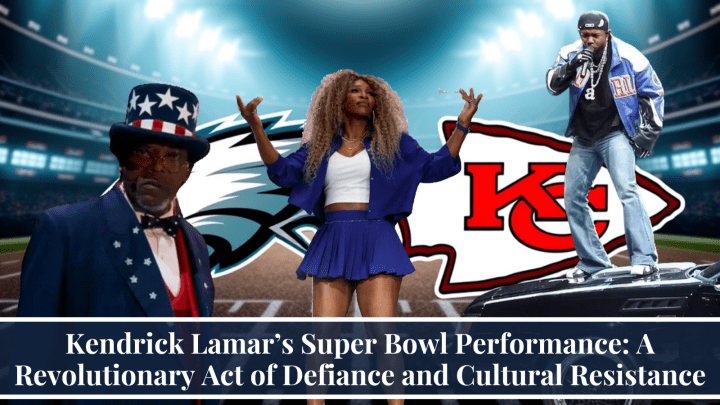
Kendrick Lamar’s Super Bowl halftime show in 2025 wasn’t merely an opportunity to entertain millions—no, this performance was a seismic cultural event. It transcended the realm of music, art, and spectacle, emerging as a deeply revolutionary moment. Every note he played, every lyric he rapped, and every visual he used on the Super Bowl stage was a powerful statement about America’s political, racial, and social landscape.
In this performance, Lamar took one of the most commercialized platforms in the world—the Super Bowl halftime show—and transformed it into an act of defiance, critique, and cultural resistance. In doing so, he not only spotlighted the history of Black struggle and resilience but also redefined what it means to be an artist with political and social power. This wasn’t just entertainment. This was a cultural statement, a call for justice, and a demand for systemic change. Let me break down the layers of meaning in this landmark performance.
Uncle Sam and the Game of America: A Subversive Introduction
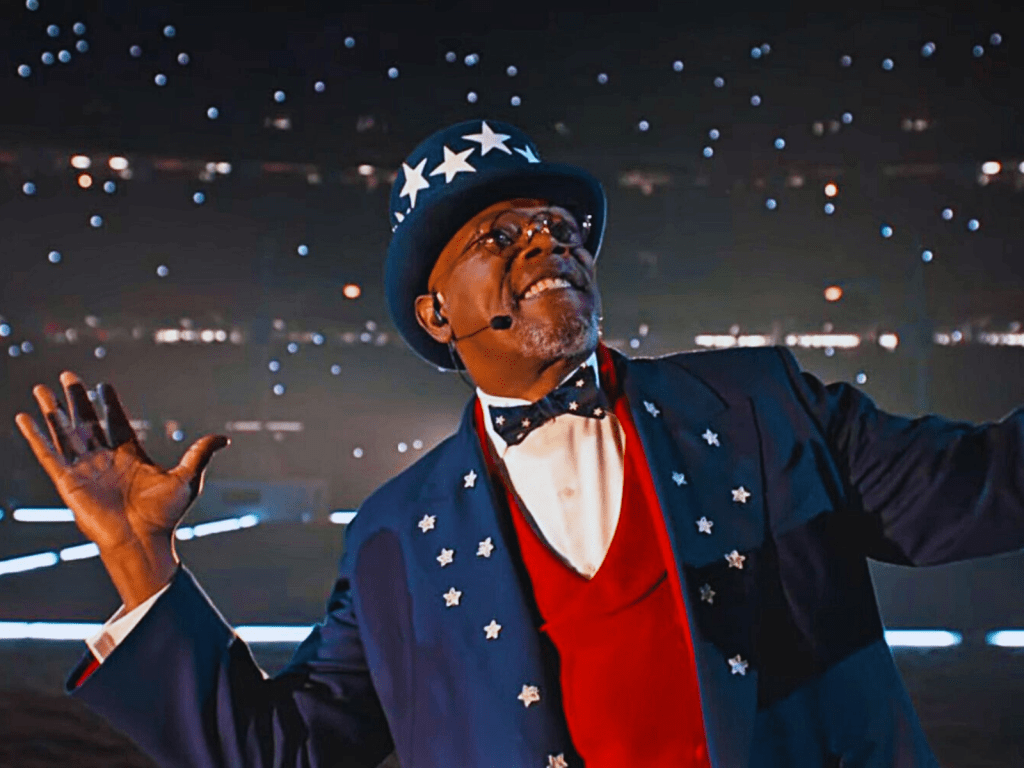
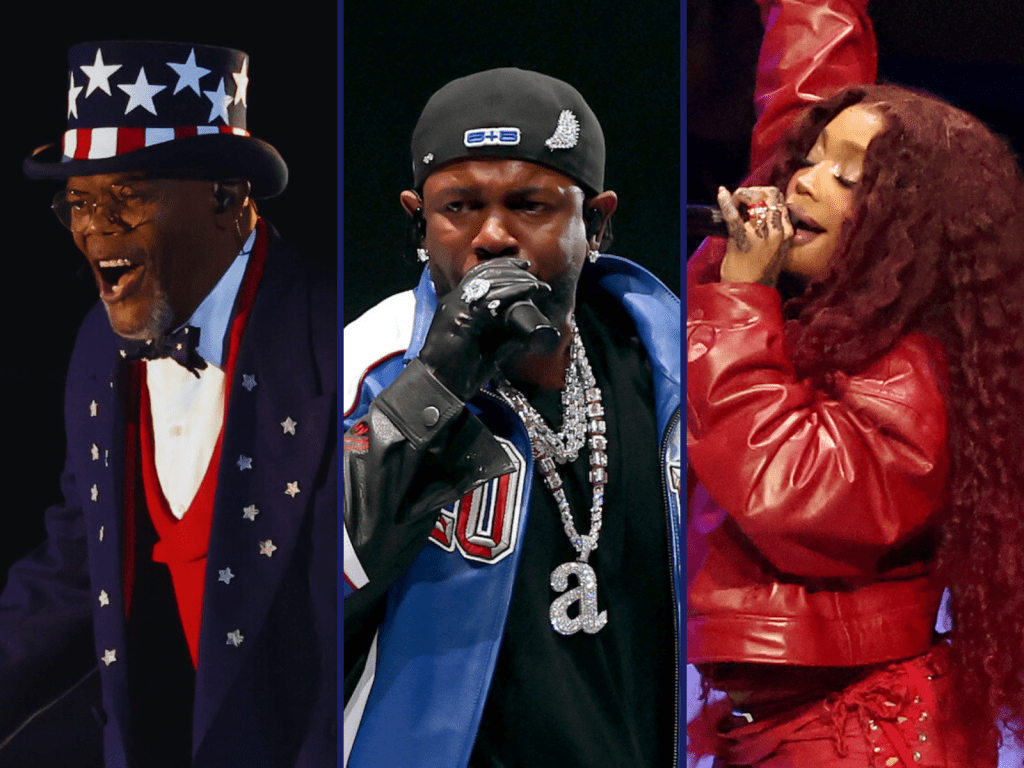
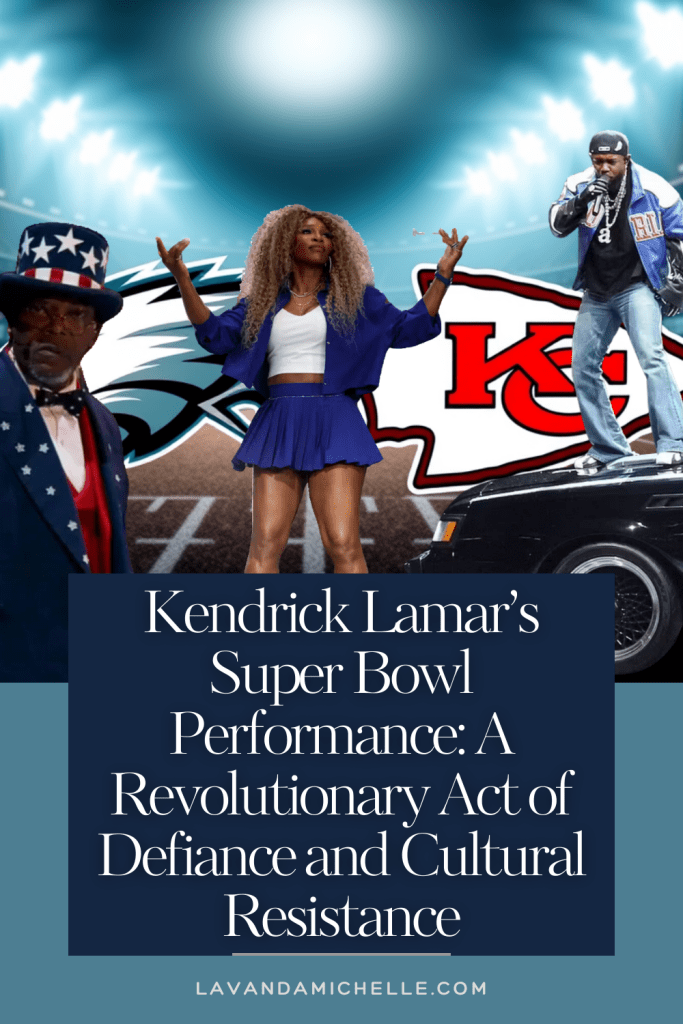
The opening moment of Kendrick Lamar’s Super Bowl performance introduced a powerful piece of symbolism that set the tone for what was to come. Samuel L. Jackson appeared as Uncle Sam, a chilling representation of America’s power structures. His words, “Welcome to the Great American Game,” aren’t just an introduction to the event—they are a critique of America’s deeper systemic issues.
This “game” isn’t just about football. It’s a metaphor for how America operates, often to the detriment of marginalized communities. Uncle Sam, in this performance, isn’t a figure of unity and freedom. He represents the systems of control, oppression, and surveillance that govern American life—particularly how they affect Black Americans. Jackson’s portrayal of Uncle Sam critiques how Black Americans have been treated as outsiders, told that they are “too loud, too reckless, too ghetto.” This direct statement attacks the pervasive and deeply ingrained stereotypes that portray Black people as threats in a country that purports to uphold ideals of freedom and equality.
Kendrick’s defiant presence on stage in response to this is a symbol of resistance. While Uncle Sam represents the oppressive system, Kendrick Lamar’s performance is an act of rebellion, a challenge to this status quo, and a demand for recognition, equality, and respect. Lamar’s performance is a direct commentary on how the systems that claim to protect freedom often marginalize the very communities who built this nation.
The Revolution Will Be Televised: Taking Back the Narrative
A pivotal moment in Lamar’s performance was his declaration, “The revolution will be televised.” This was not a throwaway line—it was a direct challenge to the historical narrative about social movements. It reclaims and reinterprets the words made famous by Gil Scott-Heron’s “The Revolution Will Not Be Televised,” which critiqued the ways mainstream media ignored or distorted political and social uprisings.
Kendrick flips that narrative entirely. In 2025, the revolution is not only televised—it is broadcast to millions of people around the world, front and center during the Super Bowl, the pinnacle of mainstream, commercialized culture. By choosing this high-profile, widely consumed platform, Kendrick asserts control over the narrative, amplifying voices that have been traditionally marginalized in mainstream media.
His performance makes a clear and bold statement: the revolution is no longer something that happens in the shadows, away from the public eye. It is loud, it is visible, and it is happening now, in real time, on the world’s most watched stage. Kendrick has taken the revolution from being a quiet, behind-the-scenes effort to a loud, unmissable event.
Time Reversed: Undoing a History of Oppression
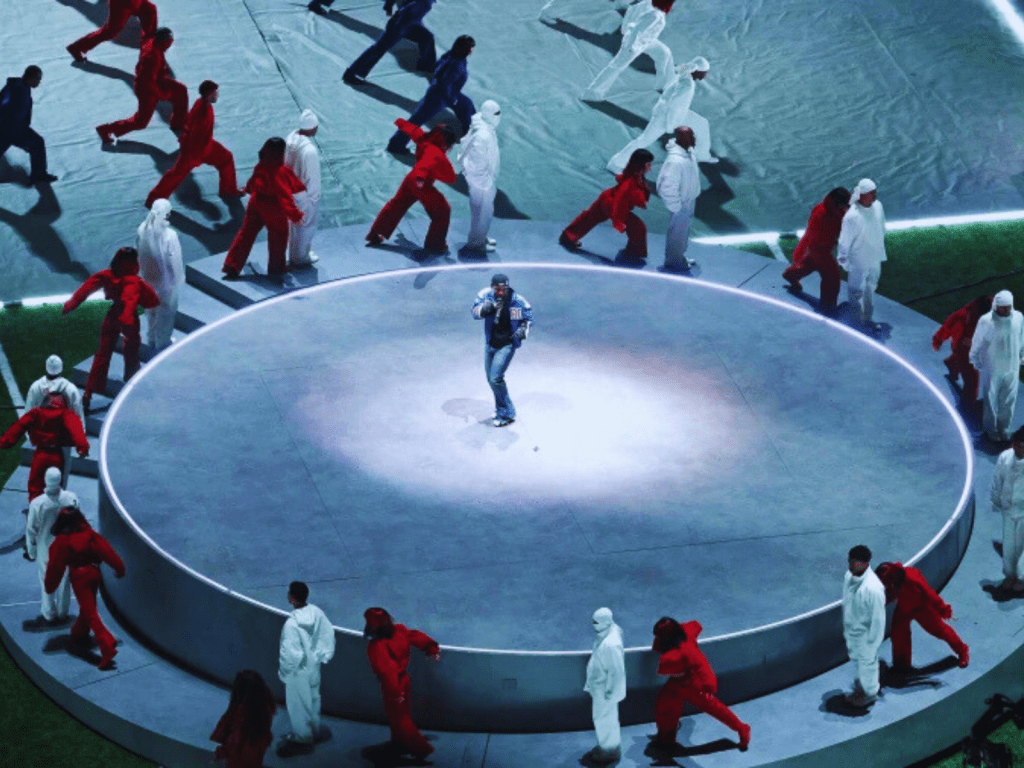
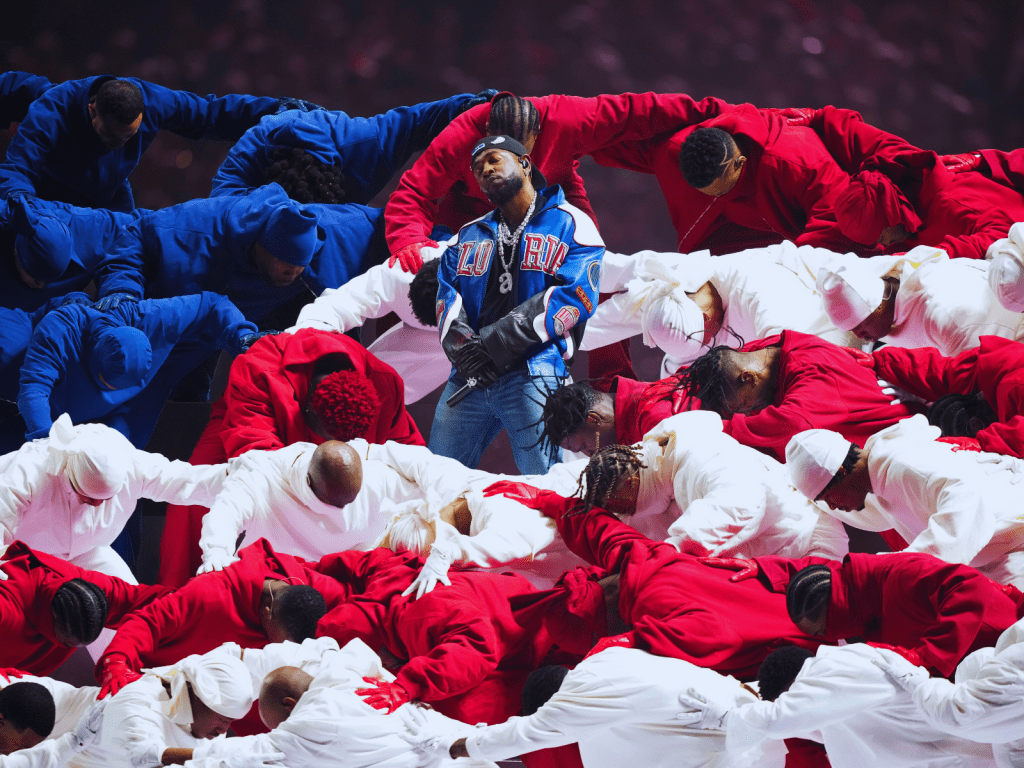
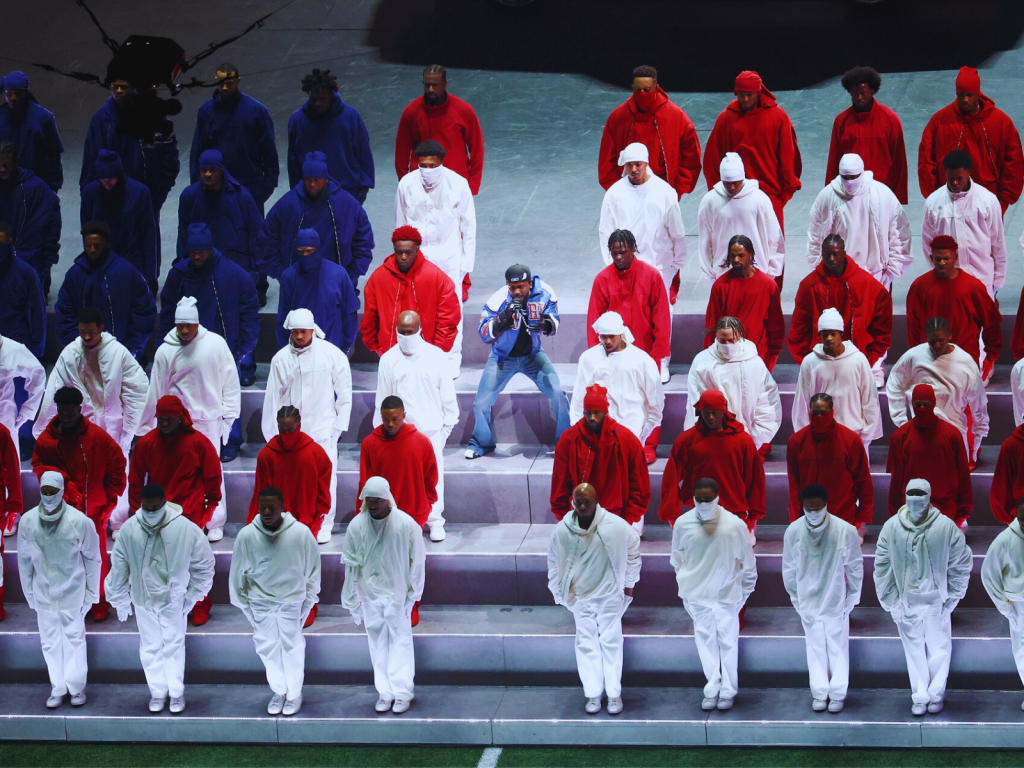
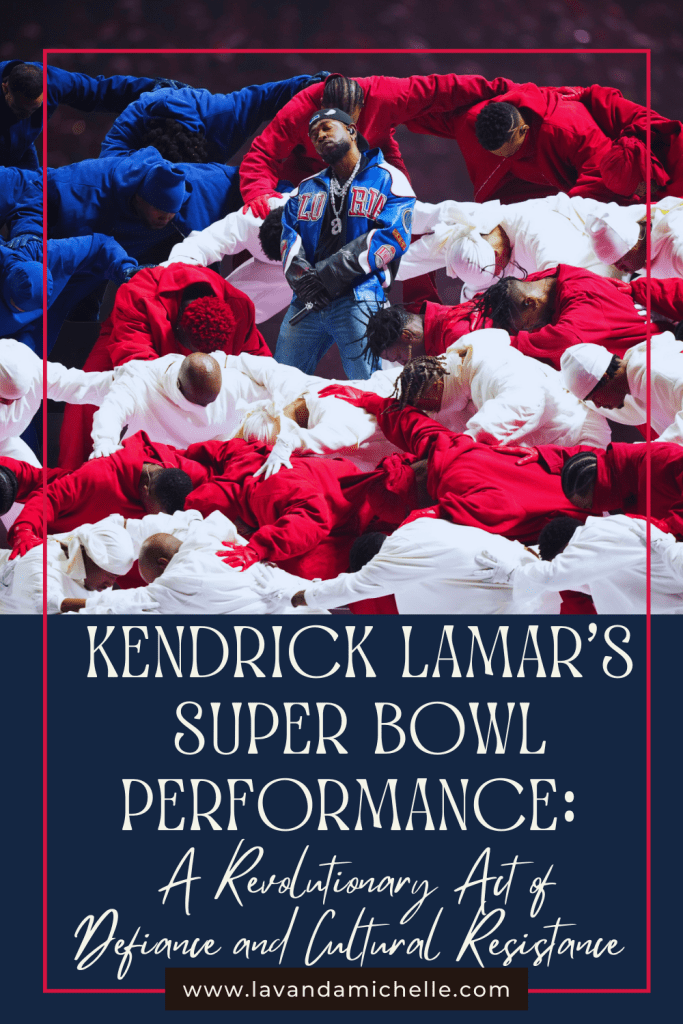
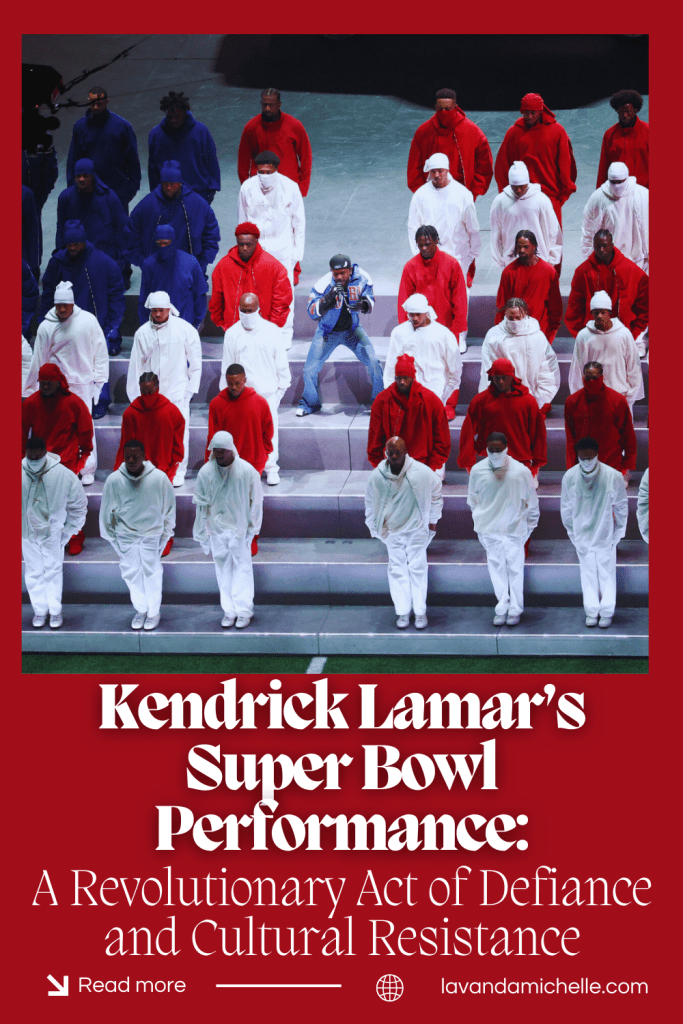
The dancers who accompanied Lamar were integral to the visual storytelling, with their counterclockwise movements acting as a powerful metaphor for reversing time. This movement wasn’t just about choreography—it was an intentional statement, urging the audience to rethink history, undo the injustices of the past, and correct the systemic oppression that has continued into the present.
As the dancers formed the American flag during Lamar’s performance of “HUMBLE,” the imagery took on a powerful double meaning. While the American flag is traditionally seen as a symbol of freedom and democracy, in this context, it serves as a pointed critique of the country’s unfulfilled promises. The flag, while still iconic, becomes a symbol of the hypocrisy within the ideals of America. While the flag stands for justice and equality, these ideals have historically been denied to Black Americans.
Through this visual, Kendrick Lamar reminds the world that the promises of freedom and equality embedded in the American flag are hollow until they are fulfilled for all citizens, particularly for Black Americans. His use of the flag and the reversal of time calls for reflection, change, and a commitment to racial justice.
40 Acres and a Mule: A Broken Promise of Freedom
One of the most powerful moments in Lamar’s performance came when he referenced the phrase “40 acres and a mule.” This reference serves as a poignant reminder of the unfulfilled promise made to formerly enslaved Black Americans after the Civil War. The phrase isn’t just a historical reference—it is a call for reparations, justice, and the acknowledgment of America’s broken promises to Black Americans.
The concept of 40 acres and a mule originated from Special Field Order No. 15, issued by Union General William T. Sherman in 1865. This order was a radical policy aimed at redistributing land from Confederate landowners to freed Black families, granting them the opportunity to rebuild their lives with 40 acres of tillable land and a mule to work it. For the first time in American history, the government asked Black leaders what they needed to build a future after slavery. This policy was an attempt at reparations, a way to give formerly enslaved people the tools to achieve economic independence.
Unfortunately, this promise was never fulfilled. Instead, the government reneged on its commitment, and the land was returned to the original Confederate landowners. For Black Americans, this betrayal marked the beginning of a long history of systemic exclusion from opportunities that would allow them to achieve economic security.
Kendrick’s reference to this broken promise wasn’t just a historical lesson—it was a direct call to acknowledge the continued injustice faced by Black Americans, particularly in terms of economic disparity. The ghosts of broken promises like these still haunt the Black community today, and Kendrick’s performance serves as a call to right these wrongs and fulfill the promises that were never kept.
The “A Minor” Necklace: Symbolism of Resistance, Power, and Leadership
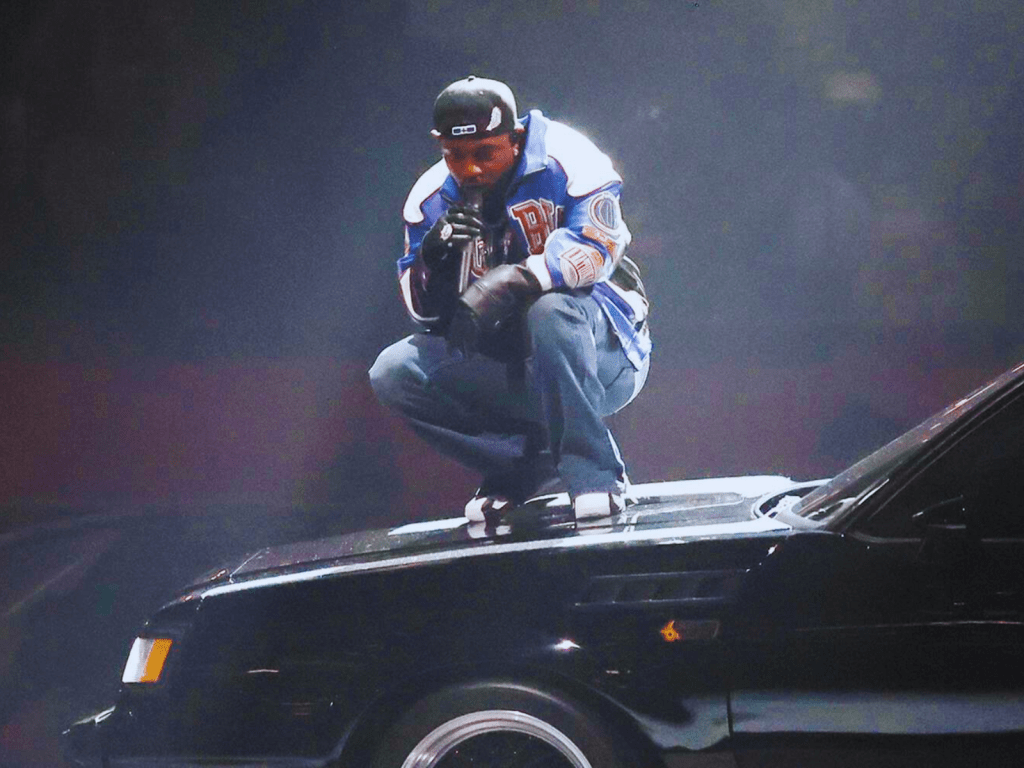
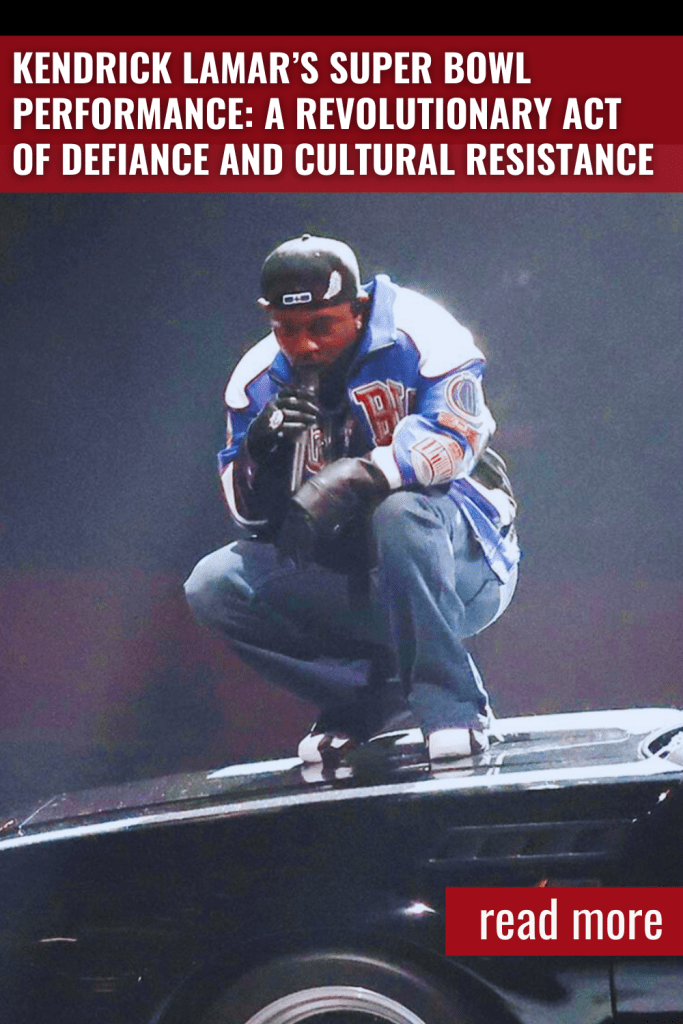
Kendrick’s “A Minor” necklace—an understated but significant symbol—was central to his performance. While many speculated that the lowercase “a” was a reference to his ongoing tension with Drake, its true meaning transcends any personal feud. The necklace served as a symbol of Kendrick’s resistance against the music industry’s exploitation of artists and a larger commentary on the way power is traditionally understood in the world of hip-hop.
The lowercase “a” is a direct rejection of the loud, forceful power associated with traditional “alpha” figures. Instead, Kendrick is redefining what it means to lead. The lowercase “a” represents Kendrick’s quiet, but profound, influence. It is power that doesn’t need to be announced or loudly proclaimed. It is power rooted in cultural authority, authenticity, and resistance.
Through the “A Minor” necklace, Kendrick Lamar sends a message: you don’t need to shout to be heard. True leadership comes from influence, respect, and the ability to shape the culture around you. By positioning himself as the “Alpha” in this understated way, Lamar redefines power in hip-hop—proving that leadership can be subtle but still incredibly powerful.
Kendrick Lamar: The Alpha, The GOAT, and the Greatest of All Time
Through his performance, Kendrick Lamar redefines what it means to be the “Alpha” in hip-hop. He doesn’t need to boast or dominate the conversation. Kendrick shows up, and the culture listens. His impact is felt in the way he shapes the conversation, challenges systems of power, and uses his platform to speak out on important issues.
By choosing to use his Super Bowl performance as a stage for resistance and cultural commentary, Kendrick proves that being the “Alpha” in the modern era isn’t about being the loudest or most aggressive—it’s about authenticity, resilience, and a willingness to challenge the status quo. Lamar isn’t just an artist; he is a leader, shaping the direction of hip-hop and culture at large.
The Message to America: Stand Up and Resist
Lamar’s performance wasn’t only a critique of the music industry—it was a message to America. Through his performance of “Not Like Us,” Kendrick directly addressed systemic inequality, particularly the continued oppression of Black Americans.
The inclusion of Serena Williams, a fellow Compton native, performing the iconic Crip walk, served as a powerful visual statement of solidarity within the Black community. Even in the face of systemic oppression, Kendrick and Serena reminded the world that Black culture will not remain silent—it will rise, resist, and demand change.
Kendrick’s performance called for action. His message to America was clear: it is time to stand up, resist, and push back against the systems that continue to oppress marginalized communities.
Ending with a Bold Statement: “GAME OVER”
The final message displayed at the end of Lamar’s performance was nothing short of a declaration: “GAME OVER.” This wasn’t just an ending to the performance—it was a call to end the old systems of power that have kept people oppressed, divided, and silenced.
By closing with this bold declaration, Kendrick Lamar signaled that the revolution is no longer a hopeful, distant future—it is now. The old ways are crumbling, and a new era of resistance, empowerment, and social justice is emerging. Kendrick’s “GAME OVER” wasn’t just a message for the Super Bowl audience; it was a call to all of America to stand up, resist, and be part of the cultural revolution.
A Revolutionary Performance
Kendrick Lamar’s Super Bowl halftime performance was a masterclass in cultural defiance and political resistance. Through every detail—his powerful symbols, references to history, and critique of America’s systems of oppression—Kendrick delivered a message that extended far beyond music. His performance was a cultural statement, a demand for justice, and a call for revolution.
From the “a” necklace to the reference to “40 acres and a mule” to the final “GAME OVER” message, Kendrick Lamar made it clear: the revolution isn’t coming—it’s already here. And Kendrick is leading the charge for justice, equality, and cultural change.

What are your thoughts about the Kendrick Lamar’s Super Bowl Performance: A Revolutionary Act of Defiance and Cultural Resistance Please share in the comments below. I really would love to know.
Until next time, shine amongst the stars!
‘This post may contain affiliate links
If you haven’t made enough money blogging, look into taking the
Complete Guide to Make Money Blogging for only
($10… WOW 95% Off for a limited time).
Kendrick Lamar’s Super Bowl halftime performance was a revolutionary moment blending music & resistance. 🎤 Dive into the powerful messages behind the symbolism & how Kendrick redefines leadership. #KendrickLamar #SuperBowl2025 #CulturalResistance #HipHo

I was already charged up while watching and after the performance, but reading this just invigorated me that much more to not just be an observer of this revolutionary moment; I feel like One in A Movement of Millions who will take this as an initiation of Cultural Change Agents among We, the oppressed and denied. Let’s GO!