

It is one of the most painful, helpless feelings in the world: watching a brilliant, loving friend pour her heart, soul, and sanity into a relationship, trying desperately to “fix” a man who is essentially following a manual on how to be unfixable.
If you are watching someone you care about slowly shrink themselves to fit into the increasingly rigid boxes of her partner’s new “Alpha” worldview, you aren’t just watching a normal relationship rough patch. You are watching her fight a ghost.

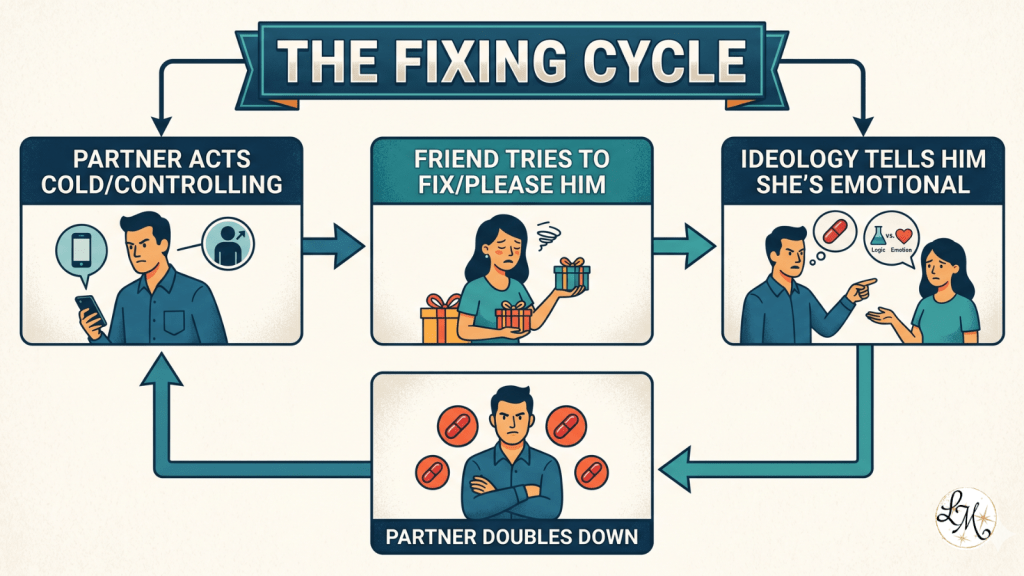
The modern “Red Pill” ideology—and the toxic corner of the internet’s manosphere that peddles it—is designed specifically to be a closed loop. It is a psychological trap. If she tries to help him, communicate her hurts, or point out his flaws, his “manual” has a ready-made defense mechanism: she is just being “emotional,” “irrational,” or “disrespectful.” This toxic framework transforms her genuine love and concern into proof of his internet-fueled theories, causing him to double down on his cold, controlling behavior.
When a friend is trapped in the “I can change him” stage, she isn’t actually in love with the person standing in front of her. She is hooked on the ghost of who he used to be—the version of him she saw at the very beginning, before the podcasts, the forums, and the aggressive posturing took over his personality.
So, how do you save a friend who is drowning in someone else’s algorithmic brainwashing without drowning her relationship with you? You can’t force her to leave, but you can change the way you support her while she is still in that “fixing” cycle. If you want to know how to stop trying to fix him and help her do the same, use these five compassionate strategies.

5 Ways to Help Her Deconstruct the Illusion
1. Use the “Pattern” Strategy
When we love someone, our instinct is to protect their character. If you tell your friend, “He is bad,” or “He is treating you terribly,” her instinct will be to defend his core self. Instead of attacking him, shift the focus to the pattern.
The next time she shares a heartbreaking story about him being uncharacteristically cold, stonewalling her, or trying to implement arbitrary “rules” in the relationship, ask her a gentle but piercing question:
“Does it feel like you’re talking to the man you fell in love with, or does it feel like you’re talking to a YouTube script?”
This question is incredibly powerful. It helps her separate the man she loves from the toxic persona he’s adopted. It allows her to realize she isn’t actually fighting him—she’s fighting an entire online brainwashing system. By framing the ideology as an outside parasite, she can look at his behavior more objectively without feeling like she has to defend his soul.
2. Ask, “What’s the End Goal?”
When someone is caught up in the hyper-fixation of trying to change a partner, they are living minute-to-minute, fight-to-fight. They aren’t looking at the horizon. You need to gently push her to look at the finish line.
Ask her, “If you finally ‘fix’ him, what does that actually look like?” Get specific:
- Does it mean he completely stops watching the videos and listening to the podcasts?
- Does it mean he genuinely starts respecting your career and ambition, rather than viewing it as a threat?
- Does it mean he stops viewing you as an adversary to be conquered and starts seeing you as a partner?
If she is forced to articulate the end goal, she will likely realize that fixing him doesn’t just mean getting him to apologize for a single argument. It requires him to completely dismantle his entire worldview. When she sees the sheer scale of what she’s trying to change, the impossibility of the task will begin to set in.

3. Do an “Energy Check”
The “fixing” stage of a relationship is utterly exhausting. Because he has been taught to withdraw his affection to maintain “frame” and control, she is likely doing 100% of the emotional labor just to keep the relationship at baseline stability.
Bring her back to her own reality with an energy check:
“How much of your day is spent worrying about his mood, his triggers, or his ‘rules’ versus how much of his day is spent worrying about yours?”
When she is forced to look at the massive, staggering imbalance of effort, the reality of the relationship becomes impossible to ignore. She will begin to see that she is running herself ragged for someone who is actively being taught that caring about her comfort is a sign of “beta” weakness. Learning how to stop trying to fix him starts with realizing how much of yourself is being erased in the process.

4. Don’t Debate the Ideology
It is incredibly tempting to pull up articles, statistics, and feminist theories to prove to her how toxic, sexist, and deeply flawed the Red Pill ideology is. Don’t do it.
If you try to prove the ideology is wrong, she will feel a subconscious need to defend her choice in a partner, which will inadvertently push her closer to his side. Instead of focusing on the politics of the internet, focus entirely on her human experience.
| Instead of Saying… | Try Saying… |
| “That internet ideology is completely sexist and regressive.” | “It makes me sad to see you so stressed out trying to please someone who seems determined to be unhappy with you.” |
| “He’s just using manipulation tactics he learned online.” | “I notice that every time you try to share your feelings, you end up being the one apologizing. That must feel incredibly lonely.” |
By centering her feelings rather than his politics, you keep the conversation grounded in reality, not internet debates.

5. Plant the “True Strength” Seed
The entire foundation of the “Alpha” and “Red Pill” world claims to be about strength, leadership, and masculinity. But in reality, it is rooted in deep, trembling insecurity and a profound fear of women. You can gently remind her of what real strength actually looks like.
“Real leaders don’t need to constantly remind people they’re in charge, and real men aren’t terrified of their partner’s success. It sounds like he’s actually operating out of a lot of fear right now, and that is simply not your burden to carry.”
By redefining strength for her, you chip away at the glamorized image of the “unbothered, stoic Alpha” he is trying to play. You expose it for what it is: a fragile mask worn by someone who is afraid to be vulnerable.
The Hard Truth for You, the Friend
Supporting a friend in this cycle requires a massive amount of emotional stamina from you, too. You have to accept a frustrating truth: she might stay longer than you want her to.
She may look right at the red flags, acknowledge them, and still walk right back into the fire.
The absolute best, most crucial thing you can do during this time is to stay connected. The entire “Red Pill” playbook relies on isolation. It teaches men to cut off “low-value” influences—which often means her friends and family who see through his act. If your friend feels judged, criticized, or lectured by you, she will stop telling you the truth about what is happening behind closed doors out of shame.
Keep your boundaries intact, but keep the door wide open. Don’t lecture, don’t scold, and don’t say “I told you so.” Be the safe harbor.
The moment he pushes her too far, the moment the script cracks and she realizes the man she loved isn’t coming back, you need to be the very first person she feels safe enough to call.


What are your thoughts about Stop Trying to Fix Him: How to Help a Friend in a Toxic Relationship Loop Please share in the comments below. I really would love to know.
Until next time, shine amongst the stars!
‘This post may contain affiliate links


If you haven’t made enough money blogging, look into taking the
Complete Guide to Make Money Blogging for only
($10… WOW 95% Off for a limited time).


Watching a friend exhaust herself trying to “fix” a partner trapped in toxic online ideology? 💔 Stop debating the scripts and learn 5 compassionate ways to help her see the reality and break the loop. 👇

